

Member Interview: Author-Illustrator C.S. Jennings
Created September 05, 2026 by Ryan Regalado
Check out this wise “Whoo’s-Whoo” of Austin SCBWI
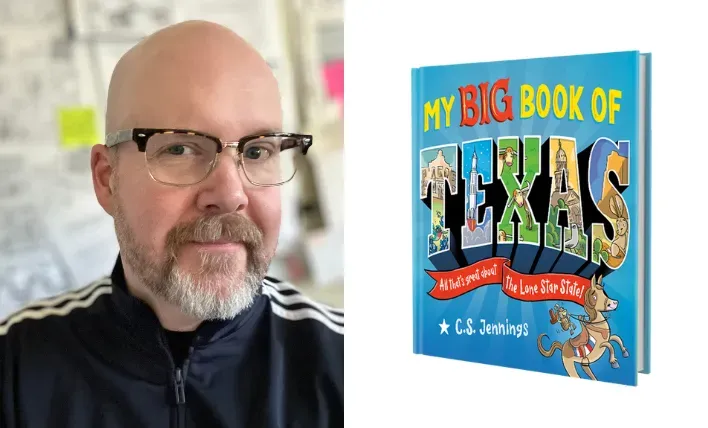
C.S. Jennings
Welcoming author-illustrator C.S. Jennings to our Member Interview Series is like welcoming him home. It was during his past tenure as one of the Austin chapter’s Illustrator Coordinators that he led by example in warmly welcoming other writers and illustrators to the chapter with friendly positivity. Christopher is author-illustrator of WHOA PANDA! (Nancy Paulsen Books, 2025); PET SHOP RACERS, a three-volume graphic novel series for young readers (Disney Hyperion, 2025); MY BIG BOOK OF TEXAS (Grosset & Dunlap, 2026); BISON & BEAR (a 4-book graphic novel series; Penguin Workshop, forthcoming 2028); and ANIMAL BAND and HELLO, TEXAS! (As Christopher S. Jennings; 2008, 2010). Notably, he illustrated the Texas Library Association Bluebonnet 2020-2021 Master List book, FROM AN IDEA TO DISNEY, as well as other books in the FROM AN IDEA TO series by Lowey Bundy Sichol. He is also the the illustrator of other children’s books through collaborations with Penguin Random House, Disney Hyperion, Scholastic, Houghton Mifflin, and Dial Books for Young Readers, and is represented by Timothy Travaglini of Transatlantic Agency. Furthermore, you can reference Christopher’s IMDB page to see how he has applied his storytelling and character development skills to animation, working with Richard Linklater as Assistant Animation Director on Apollo 10 1/2: A Space-Age Adventure (2022), and for The Tornante Company’s Amazon production Undone (2019-2022).
Where did you grow up, and how did that place (or those places) shape your work?
I grew up in Texas—west, central, and north. Texas’s vastness, natural surroundings, generosity, and just good manners—thanks to my grandma Judy—is baked deeply into the way I see the world.
My family has been here for seven generations, so there’s an inherited sense of place. I love that you can drive across this state and literally pass through completely different worlds—ten ecoregions in all!
That curiosity about place shows up in My Big Book of Texas, which is my love letter to the state. It’s also there in Bison & Bear. I’m an amateur naturalist and spend a lot of time hiking, biking, poking around outside, and wondering, “What is that thing?”
The sense of exploration—the idea that the world is enormous and strange and there is always something else to discover—is a big part of what I want to give kids.
Did you always want to be an author-illustrator, or did that come later?
Artist? Always.
Author-illustrator? That took me a while to figure out.
Someone once asked me when I knew I was an artist. The question stopped me. I never knew. Making art is a part of the fabric of who I was, has been from the beginning. Most kids draw. I just never put the crayons down.
Writing was different. I had mild dyslexia as a kid. Reading comprehension could be difficult. My mother was an educator. She gave me a journal and encouraged me to write stories. The words began to make more sense as they became tools of expression.
Professionally, though, the path wandered all over the place. I studied graphic design and illustration. I worked as a designer, art director. I became an animator. I illustrated other people’s books. I worked in advertising, publishing and entertainment.
Story, though, was always tugging at me.
Almost three decades ago I stood in the children’s section of a bookstore completely electrified by the idea that maybe—somehow—I could make books that lived on those shelves.
It took a while, yet here we are.
If someone were to follow you around for 24 hours, what would they see?
A surprising amount of sitting. Such is the life of the author-illustrator.
I start with coffee. Walk the dogs. Feed an unreasonable number of animals. I have what I call intention time—where I set my sites for the day, both schedule and internal motivation. Then into the studio.
If I’m “concepting” a book, then it’s lots of time in my sketchbook or doing research. Writing down scenes, things that relate to the piece that make me laugh and inform the character and story. Catching ideas and making. Play. No rules in this stage.
If I’m writing, I’m working in a document on my computer with my sketchbook nearby. I’ll stop to sketch or write to figure out a scene—I still do my best thinking with a pencil.
If I’m in production, I’m at my WACOM tablet. Creating spreads in Photoshop (I work in spreads, not pages). I use the Kyle Webster and the Retro Supply brushes. I work digitally (on graphic novels) but I want the results to echo my hand.
Then home and back to family. Opening the door to the house is so much fun. Pugs who are SO stoked to see me. Cats winding figure eights around my legs. Humans who are awesome.
I love cooking. I read a lot. Tinker in my studio at home. Take the dogs for a night walk and then to sleep.
How does your everyday life feed your work?
There’s not a clean boundary between “life” and “work” when you tell stories.
My pets become characters. A hike becomes a setting. Something I’m afraid of becomes something a character is afraid of. Something funny that happens at breakfast gets filed away somewhere in my brain or captured in my writing journal or the Day One app I keep on my phone.
The outdoors is especially important to me. I learn bird calls. I hike and bike around the Hill Country. Big Bend is so important to me. Moab, Utah has awe-inspiring country and vistas. The forests of the Pacific Northwest are astounding. The serene rivers and ashes of the Brandywine River Valley bring a deeper breath. I’m endlessly curious about animals, geology, weather (clouds especially) and the world around me.
That curiosity finds its way into the books.
Kids can tell when the creator is genuinely excited about something. If I’m having fun learning about bats or stars or dinosaur tracks—or whatever rabbit hole I’ve fallen into that week—hopefully some of that excitement gets transferred to the reader.
Tell us about some accomplishments that make you proud.
There are career milestones. I’m enormously grateful for them.
I’ve illustrated more than two dozen books for kids. I created Pet Shop Racers, a three-volume graphic novel series for Disney Hyperion. I wrote and illustrated Whoa Panda! and My Big Book of Texas for Penguin Random House, and I’m creating the four-book Bison & Bear graphic novel series for Penguin Workshop.
My Big Book of Texas receiving an Austin Chronicle Best of Austin Critics Pick meant a lot. Austin has been a part of my life for decades, and the award banners hang in so many of my favorite places. To have one in my studio is a special thrill.
I’m proud that From an Idea to Disney, which I illustrated, was selected for the Texas Bluebonnet Award Master List.
Animation has also been a huge part of my life. I’ve had the chance to work with Richard Linklater twice—first on A Scanner Darkly and later on Apollo 10½—and I worked on both seasons of Amazon’s Undone. Those projects involved extraordinary groups of artists, and I learned an enormous amount from them.
But, I’m also proud that I have kept going.
Creative careers look very tidy when you compress them into a paragraph. Mine took decades. There were wonderful opportunities, long, quiet stretches, rejection, uncertainty, day jobs, deadlines, and a lot of drawing when nobody was paying attention.
The longevity of working to make the thing happen is what I take satisfaction from.
What surprises you about the creative life?
Probably the biggest one, as this became my career, is how little of it happens according to your schedule.
We have this idea that if we work hard enough, the universe should eventually look at our calendar and say, “Ah, yes. Tuesday at 2:00. Your breakthrough.”
It does not.
There have been periods when everything seemed to happen at once, followed by stretches where almost nothing happened. That can be incredibly disorienting.
I’ve had to learn to respect those seasons.
The other surprise is how much creativity is really about returning.
Not relentless productivity. Presence.
A 94-page graphic novel gets made hour by hour, day by day, over months. You sit down. You make something. The next day you come back and make a little more.
As my career has expanded, that’s what the creative life means to me.
Keep returning to the work. Put yourself in the chair. Get it done.
Live it. Dwell in it. Everyday. In ways quiet and purpose filled.
When a reader discovers your work, what do you hope they find?
Humor, heart, and healing—that’s my mission statement as a creator.
First, I want kids to laugh. Laughter opens the door. Creates a common place.
Then, I hope they discover characters who are curious, imperfect, occasionally nervous, frequently ridiculous, and still capable of doing difficult things—like the reader is.
And threaded through it all, I want there to be a kernel of hope. There are a handful of books in my life that filled me with warmth and comfort. I want that for my readers too.
For emerging and reluctant readers especially, I want books to feel inviting rather than intimidating. I know what it’s like for words not to come easily.
If a kid closes one of my books feeling entertained, a little more curious about the world and maybe a little more confident about their own place in it?
These are core reasons why I do what I do.
QUICK-FIRE QUESTIONS
“From an Idea to Author-Illustrator” — some good advice for author-illustrators?
Keep the “crayons” moving.
Your taste will be better than your skill for a while. Of course it will. Make the thing anyway. It’s the only way to go deeper. (“The way is through” is one of my favorite sayings. … also, “Knocked down seven times, stand up eight.”)
Remember art began as play! Our first way of connecting to the world around us. Turn off the serious and get into the art box. Let curiosity and the thrill making the mark guide you.
Learn craft. Learn deadlines. Learn how books actually work. Pay attention to page turns, character emotions, pacing, and the way a reader’s eye moves across a spread.
Find your people.
Creative community has been enormously important in my life. Find the people who understand rejection, deadlines, revisions and trying again—and who will genuinely celebrate when something wonderful happens for you.
Then keep going.
We need your stories. We need your voice.
What makes you laugh out loud?
The completely unexpected.
A perfectly timed stupid joke. Animals behaving like tiny weird people. Someone committing 100 percent to a ridiculous bit.
My sense of humor lives somewhere at the intersection of character comedy, absurdity, and shared laughter.
Also, me. I constantly entertain myself with accents, dumb observations, and the inherent comedy of being a human. (You just have to laugh sometimes.)
Favorite birdcall?
Oh gosh. All of them? (Not true. Not a huge fan of the mourning dove’s incessant thrum. Bluejays can take it easy, man. We don’t need the ruckus ALL of the time.)
I learned a few years ago you only have to listen for who’s around. I know the calls of the regulars.
My favorite one is one I’ve never heard before. So, then it’s a hunt into the canopy, or pulling out my Merlin app to use the tool that identifies the bird. (And adding that species to my Life List. #high-five)
I do love the cardinal’s chirp and call. An owl, though, with the deep “who-who-ha-roo” makes me so happy.
If you were a watch, what type would you be?
TOUGH QUESTION! But it has to be my Hamilton Khaki Field. I’ve had it for almost two decades. The case shows the love—but the crystal is scratch-free.
I’m excited by watches that have a sense of history. Dials and design that are informed by utility. Largely, what is called “tool” watches. The Hamilton is that. It echoes the watch my grandfathers would have worn in WWII. (Personal history is important to me too. My grandfathers were good men and some of my heroes.)
The watch is also an automatic, meaning it runs through the movement of the body. The back of the watch is clear, and you can see the gears grinding around inside. I like things where you can see the craft and engineering behind them.
I love detail, though. A hidden thing only discovered when you REALLY look. The tip of the second hand on the Hamilton has a small red mark—in what is mostly a black and white design. It makes me smile. I love it.